How to Implement Effective Procurement Strategies in 2026
![7 Benefits to Building a Solid Procurement Strategy & How To Do It [2023]](https://www.order.co/wp-content/uploads/2023/04/iStock-1188425195-768x432.webp)
How to Implement Effective Procurement Strategies in 2026
Procurement professionals are always looking for ways to add value and reduce costs. With purchasing decisions affecting everything from supplier relationships to financial performance, having effective procurement strategies in place is essential for improving operational efficiency and protecting your bottom line.
This guide walks you through how to choose and implement the right procurement strategies for your business. It also covers common challenges that can derail even well-designed programs and how to avoid them.
Key takeaways
- Procurement strategies align purchasing decisions with broader business growth, cost control, and risk management goals.
- Real-time spend visibility and analytics drive informed sourcing and ongoing process optimization.
- Supplier consolidation and strategic sourcing deliver measurable savings and improve vendor reliability.
- Standardized workflows reduce maverick spend and strengthen policy compliance across locations.
- Technology-enabled procurement improves month-end close, audit readiness, and financial accuracy.
Download the free guide: The Procurement Strategy Playbook for Modern Businesses
What is a procurement strategy?
A procurement strategy is a plan organizations use to acquire goods and services efficiently and cost-effectively. Companies use procurement strategies to ensure they partner with trustworthy suppliers, secure pricing benefits, and lower their risk profile. When applied effectively, they keep every purchase aligned with high-level priorities and operational success.
Key types of procurement strategies used by leading organizations
Top-performing teams rarely rely on a single procurement approach. Instead, they combine multiple strategies to drive cost control, process speed, and risk mitigation.
Cost reduction and value optimization strategies
Cost reduction involves more than getting the lowest price. It focuses on total cost of ownership (TCO), demand management, and workflow optimization.
A recent McKinsey report found that 39% of businesses saw supplier and material costs rise in 2025, while 30% noted a drop in customer demand. This dual pressure on margins makes a proactive cost reduction strategy essential.
Common approaches include:
- Consolidating suppliers to increase volume leverage
- Benchmarking products against market rates
- Negotiating volume discounts
- Sourcing comparable alternatives to lower prices without sacrificing quality
- Forecasting demand to avoid rush orders and premium shipping
For example, an organization centralizing purchasing across 50 sites might consolidate office supply vendors from eight to two. This allows it to negotiate a 12% price reduction and eliminates duplicate SKUs, resulting in lower unit costs and simpler inventory management.
Value optimization also requires removing internal inefficiencies. Standardizing intake through digital workflows reduces cycle times and manual errors, directly lowering administrative overhead. Implementing purchase order automation takes this further by scaling those gains across departments without adding headcount.
Supplier relationship and risk management approaches
Disruptions, cybersecurity threats, and geopolitical instability have moved supplier risk from a theoretical concern to a daily reality. According to Deloitte’s 2025 Global CPO Survey, 74% of procurement leaders now view finding alternative suppliers as the most effective mitigation strategy.
Other proactive approaches include:
- Performing security and compliance reviews during onboarding
- Conducting continuous supplier performance evaluations
- Standardizing contracts and auditing renewals
- Centralizing insurance and certification records
Effective supplier lifecycle management ensures vendors are vetted from onboarding to offboarding. Beyond mitigating risk, strong relationships create leverage during negotiations and improve responsiveness during shortages.
Finalizing your strategy also requires standardizing upstream processes, such as structured purchase requisition approval workflows, to ensure proper due diligence before you make a commitment.
Sustainable and ethical procurement methods
Sustainable procurement reduces environmental impact while improving brand trust and regulatory compliance. With new global mandates in place, over 70% of companies now cite delivering on sustainability goals as a top procurement driver.
To meet these goals, focus on:
- Sourcing eco-friendly or recycled materials
- Evaluating supplier carbon disclosures
- Reducing warehousing and transportation footprints
- Partnering with vendors committed to ethical labor standards
These methods often reduce costs over time through energy efficiency, waste reduction, and smarter logistics. They also strengthen resilience by diversifying supplier networks and ensuring alignment with evolving regulatory standards.
The Procurement Strategy Playbook for Modern Businesses
Learn the key pillars of a strong strategy, valuable procurement metrics to track, and initiatives you can start implementing today.
Why is having a procurement strategy important?
A clear procurement strategy makes it easier to secure the right products and services at the right price, allowing you to stay within budget, avoid unnecessary costs, and build a more resilient supply chain. When properly implemented, it also helps you identify potential risks, mitigate fraud, and maintain high supplier performance.
Benefits of building a procurement strategy
Strong procurement strategies deliver measurable business outcomes, especially for multi-location operators. The main benefits of improving your procurement strategy include:
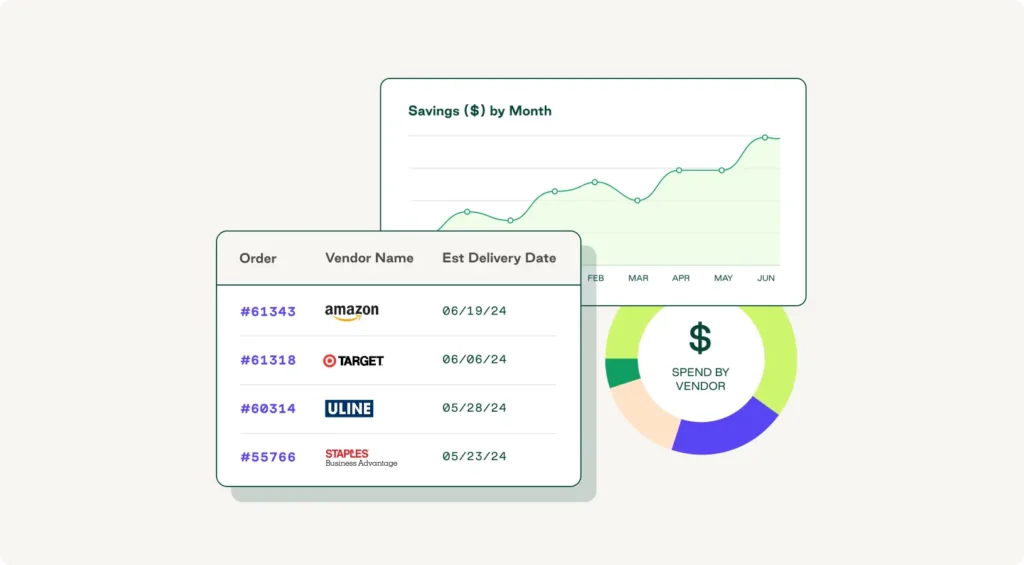
- Greater spend visibility and control: Centralized purchasing data eliminates silos, allowing finance teams to track real-time spend by category, location, and vendor. This improves budgeting accuracy and reduces rogue spending.
- Operational consistency across locations: A unified purchase order process ensures every location follows the same approval, documentation, and compliance rules, simplifying audits and enabling accountability.
- Improved cost management and pricing: Structured sourcing and benchmarking uncover savings by reducing vendor and product duplication, which enables stronger contract negotiations.
- Reduced operational and third-party risk: Formal supplier onboarding, digital approvals, and automated controls lower fraud risk and compliance gaps. Central oversight prevents contract drift and unauthorized purchases.
- Faster cycle times and increased financial accuracy: Automation accelerates intake, approval, and invoicing—reducing bottlenecks and accelerating month-end close. Implementing invoice approval software strengthens reconciliation accuracy.
How to develop and implement effective procurement strategies
Modern procurement strategies must be practical, scalable, and data-driven, especially for growing businesses managing multiple locations.
Assess organizational needs and spend analysis
An effective strategy begins with establishing a baseline of current spending. Aggregate purchasing data across departments and locations, then categorize that spend by vendor, category, payment method, and contract status.
This analysis helps you uncover:
- Supplier fragmentation
- Maverick spend
- Contract leakage
- Duplicate products
Detailed spend analysis provides the necessary foundation for strategic decision-making. Without it, procurement remains reactive rather than proactive.
Start the supplier selection and negotiation process
Moving from raw data to structured sourcing requires a centralized system. Use modern procurement software to consolidate vendor information, approval workflows, and performance tracking in a single system.
With this infrastructure in place, you can execute a more rigorous selection and negotiation process:
- Define category strategies based on volume and risk
- Benchmark pricing against market standards
- Issue RFPs or conduct competitive bidding where appropriate
- Negotiate volume discounts and performance-based incentives
- Formalize contracts with clear SLAs and renewal checkpoints
After you choose your vendors, use a standardized purchase order template to formalize every transaction. This ensures all orders reflect your negotiated pricing and compliance terms, creating a clean data trail for the next stage of the process.
Measure performance and continuous improvement
Procurement strategy is not static. Continuous improvement ensures your operations remain efficient and your vendor relationships stay productive.
To measure performance, track metrics like:
- Spend Under Management: Measures how much of the total company spend the procurement team actively manages and influences.
- Cost Savings and Avoidance: Tracks the measurable expenditure reductions procurement initiatives deliver to the bottom line.
- Purchase Order Cycle Time: Calculates the average time elapsed from the moment a team submits a requisition to the final issuance of a purchase order.
- Contract Compliance Rate: Monitors the percentage of purchases employees make using pre-negotiated, agreed-upon contracts.
- On-Time Delivery Performance: Evaluates how often suppliers meet the required delivery dates for ordered goods and services.
Since regular reporting highlights gaps and informs future sourcing decisions, revisit supplier performance quarterly and reassess contracts annually. Using automation tools, such as purchase order creation software, improves tracking accuracy and reduces the manual errors that often skew performance data.
Common challenges in procurement strategy implementation and how to solve them
Even the most thoughtfully designed procurement strategies can stall during implementation. The issue isn't usually the strategy itself, but the friction that surfaces when new processes meet old habits, decentralized teams, and fast-moving operations.
Here’s where growing businesses tend to struggle, and what successful organizations do differently.
Stakeholder resistance and lack of buy-in
Procurement changes sometimes feel like hurdles. If your teams are accustomed to selecting their own vendors or making expedited purchases using company cards, centralized controls can seem overly restrictive.
The problem is perception, not control. If procurement rolls out new policies without demonstrating clear benefits, stakeholders focus on what they’re losing (autonomy) rather than what they’re gaining (cost savings, speed, and visibility).
To create better buy-in:
- Share spend data that highlights inefficiencies or duplicate vendors
- Demonstrate early savings wins from supplier consolidation
- Show how standardized workflows reduce back-and-forth emails
- Provide dashboards that give departments visibility into their own budgets
Transparency builds trust. When your team members see improved outcomes like lower costs, fewer billing issues, and faster approvals, buy-in increases naturally.
Inconsistent adoption across multiple locations
For multi-location operators, scaling a procurement strategy means complexity multiplies. One location follows policy. Another reverts to old habits. A third uses a different vendor entirely.
Over time, inconsistency erodes savings and creates compliance risk. To prevent this, replace difficult tools and unclear processes with standardization that's intentionally simple.
To ensure consistent adoption, establish:
- Guided purchasing workflows that make the right action the easiest action
- Pre-approved vendor catalogs that eliminate guesswork
- Clear approval hierarchies that apply across all sites
- Structured intake through tools like purchase requisition software
For 10 Fitness, centralizing and standardizing procurement across 14 separate entities with Order.co reduced monthly invoice volume by 600+ and cut processing time by 97%. By establishing an intuitive purchasing process, the gym franchise made ordering easy and compliance natural.
The Procurement Strategy Playbook for Modern Businesses
Learn the key pillars of a strong strategy, valuable procurement metrics to track, and initiatives you can start implementing today.
"*" indicates required fields
Scaling operations without increasing headcount
Growth often exposes procurement bottlenecks. More locations mean more purchase requests, more invoices, and more vendors, yet headcount rarely increases at the same pace.
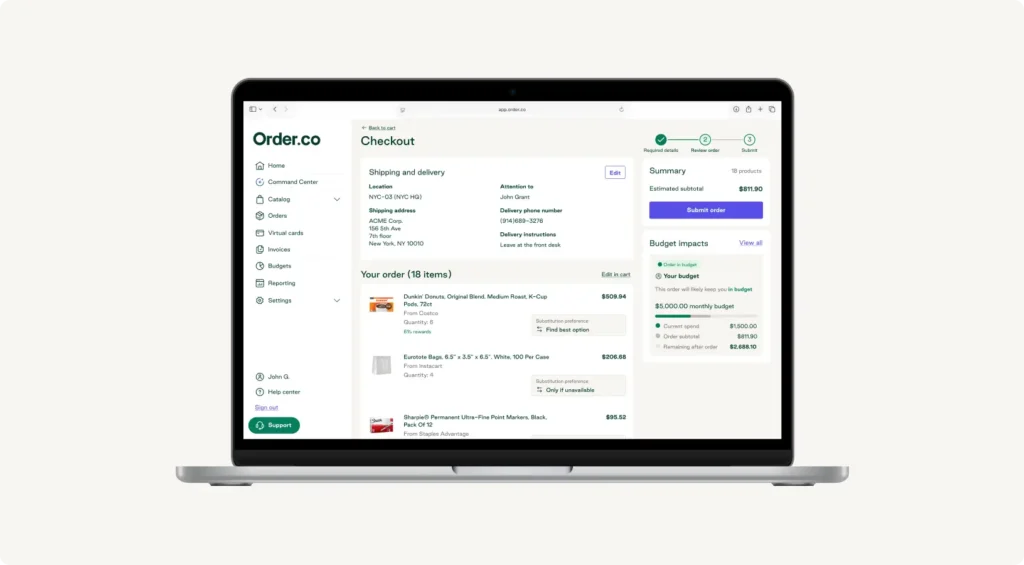
To stay ahead of this growth, replace email-based approvals, paper invoices, and disconnected payment methods with automation that transforms strategy into execution. Automated workflows reduce administrative overhead and eliminate repetitive tasks. Digital approvals accelerate cycle times. Structured payment solutions—such as virtual cards— simplify reconciliation while improving spend controls.
Maverick spend and compliance drift
Even with strong policies, maverick spending tends to creep back in if approved vendors are hard to access or processes feel slow. Employees often bypass procurement not to break rules, but to get their jobs done faster.
The solution isn’t stricter enforcement. It’s better enablement. Companies that maintain long-term compliance focus on:
- Making approved vendors easy to find and buy from
- Reducing approval bottlenecks that delay essential orders
- Providing real-time budget visibility to department leaders
- Aligning procurement with structured purchase budgeting initiatives
By centralizing purchasing with Order.co, CorePower Yoga eliminated $50,000 in monthly maverick spending—100% of the organization's unapproved spend. Replacing guesswork with line-level visibility ensures every dollar spent is now intentional and accounted for.
Maintaining momentum after rollout
Procurement strategies can lose traction after launch if performance isn’t monitored. Without regular review, organizations risk letting contracts auto-renew, savings erode, and supplier performance decline.
To keep procurement aligned with business growth, market conditions, and operational realities, treat it as an ongoing discipline rather than a one-time initiative. Schedule quarterly supplier reviews, track KPIs consistently, and refine workflows based on data.
Build procurement strategies that scale with Order.co
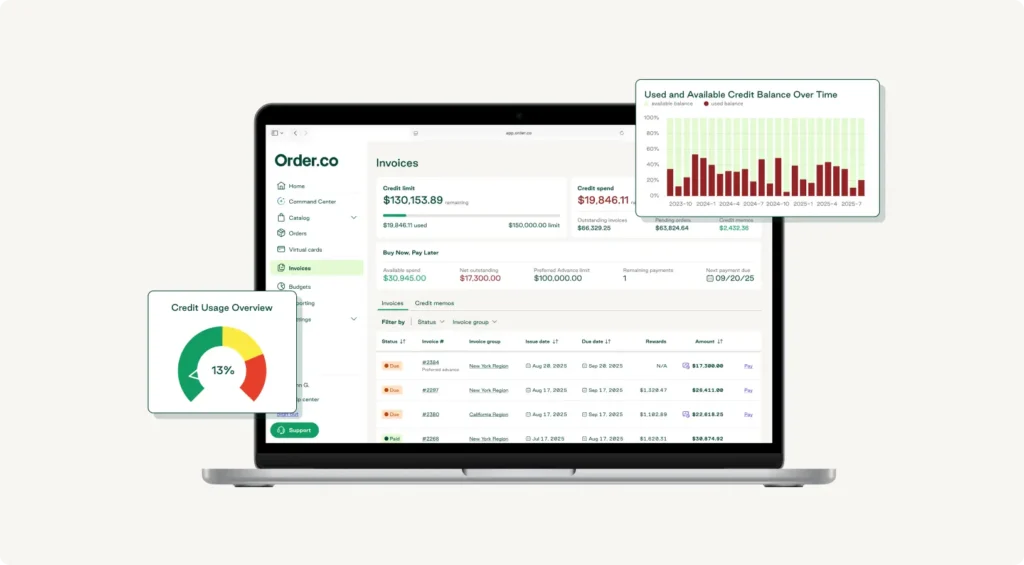
Technology is the backbone of modern procurement strategy execution. Centralized purchasing platforms eliminate data silos, enforce approval policies, and provide real-time visibility into spend, enabling finance and operations leaders to make informed, data-driven decisions.
Order.co supports scalable procurement through:
- Centralized vendor access across locations
- Automated approval workflows that remove bottlenecks
- Real-time spend tracking and reporting
- Integrated payment and reconciliation tools
Aligning technology with strategy reduces cycle times, improves compliance, and provides enterprise-wide visibility. The result isn't just better purchasing—it's stronger financial control and enhanced operational resilience.
Schedule a free Order.co demo to learn how to build and execute procurement strategies that give growing teams real-time spend control and the visibility needed to scale.
FAQs about procurement strategy
Get started
Schedule a demo to see how Order.co can simplify buying for your business.
"*" indicates required fields