Procurement Process: 7 Steps, Stages & Best Practices Guide

Procurement Process: 7 Steps, Stages & Best Practices Guide
As your company grows, so does the number of vendors, requisitions, and invoices you're tracking. What worked in a procurement spreadsheet at 20 employees breaks down at 200.
A clear, repeatable procurement process fixes that. It gives everyone, from the employee submitting a request to the finance team cutting the check, a consistent path to follow.
To create a smoother workflow at scale, it’s critical to understand:
- The seven steps of the procurement process
- How procurement differs from purchasing
- The procurement KPIs worth tracking
- How automation is the key to efficiency
Key takeaways:
- A strong procurement process has clear approval gates and spending limits so purchases move quickly but remain in control.
- Visibility into every stage, from requisition to payment, lets you catch problems before they become expensive.
- Standardizing supplier selection and onboarding cuts down on maverick spending and speeds up sourcing.
- Tracking a small set of KPIs, like cycle time and invoice exceptions, tells you where the process is actually breaking down.
- Order.co automates ordering and fulfillment for mid-market companies from the moment a request is approved to the moment it ships.
Download the free tool: Procurement KPI Tracker Template
What is procurement?
Procurement means sourcing, buying, and paying for the supplies your company needs. It's a mission-critical business activity that helps you run efficiently while keeping your staff productive and effective.
Good procurement management is a cost-saving measure too. It helps you save money through strategic buying, better supplier relationship management, and shorter ordering and delivery cycles.
Difference between indirect, direct, and service procurement
Most businesses rely on three types of procurement. Each calls for a different approach to cost control and management:
- Direct procurement: Purchases tied to production, including raw materials, equipment, resale items, or other manufacturing supplies
- Indirect procurement: Goods that don't tie back to a specific product, like office supplies, fixed assets, facilities management items, and software tools
- Service procurement: Hired services that support direct or indirect business needs, such as legal support, contract-based workers, and managed services like security, IT, or facilities maintenance
Procurement KPI Tracker Template
Download our free Procurement KPI Tracker Template today to monitor essential procurement numbers and demonstrate value in your procurement strategy.
The 7 steps of the procurement process
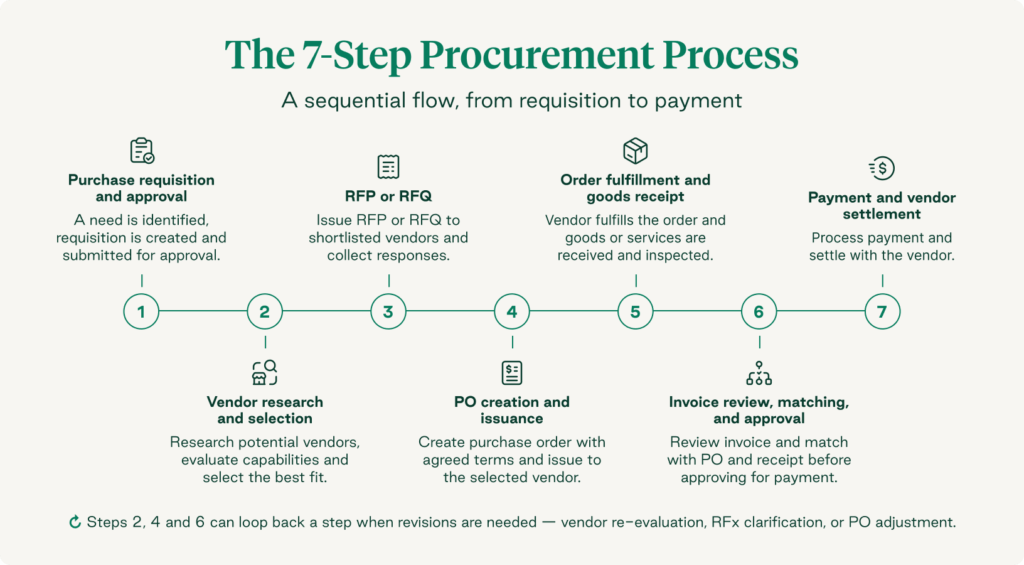
Most procurement systems follow the same basic progression: someone identifies a need, the organization approves and sources it, and the purchase gets paid for and recorded. Here's how that plays out in practice, step by step, including where approvals loop back and where a request for proposal might send you back to the sourcing stage.
1. Purchase requisition and approval
Start by outlining what you need: the product or service, quantity, required features, and budget. Fill out a purchase requisition with those details, then route it through approval workflows, which may include department heads, finance, legal, IT, or security depending on the purchase.
This step matters most when you're working with a new vendor, since approvers are checking for compliance and security risk, not just cost.
2. Vendor research and selection
Identify which vendors can meet your needs. For established categories, you might pull from a list of preferred vendors. For something new, you may research options based on price, quality, reliability, and terms.
If you're using procurement software, a sourcing algorithm can do some of this work for you, surfacing better-priced vendors or alternatives when your usual pick is out of stock.
3. Request for proposal (RFP) or request for quotation (RFQ)
For large or strategic purchases, such as high-volume goods, consulting services, or software, put together an RFP or RFQ to solicit competitive bids. This lets multiple vendors submit a quote so you can compare prices, terms, and timelines before committing. You might limit the RFQ to preferred suppliers as part of a strategic sourcing program.
4. Purchase order creation and issuance
Once you've selected a vendor and gone through contract negotiations to determine pricing and payment terms, you formalize the agreement with a purchase order. The PO spells out what's being bought, at what price, and under what terms, giving both sides a record to work from.
5. Order fulfillment and goods receipt
The vendor fulfills the order, and your receiving team checks it against the PO for quality, quantity, and accuracy. If something's off, you work with the vendor to resolve it and log the issue for future vendor evaluations.
6. Invoice review, matching, and approval
Your accounts payable team reviews the invoice against the purchase order and the original requisition, a step called three-way matching. This step catches errors, duplicate payments, and fraud before money goes out the door. Once everything matches, AP codes the expense to the correct general ledger account and queues it for payment.
7. Payment and vendor settlement
Finally, AP issues payment according to the agreed-upon terms and logs the transaction. That record supports month-end close and gives you a source of truth for budgeting, contract compliance, and spend analysis going forward. It also creates audit trails.
Procurement vs. purchasing: what's the difference?
People use the terms procurement and purchasing interchangeably, but they describe different parts of the process. Purchasing is one piece of the broader procurement process.
| Procurement | Purchasing | |
| Definition | The full process of identifying, sourcing, negotiating, and paying for goods or services | The transactional act of ordering and paying for goods once a vendor is chosen |
| Timeline | Ongoing, spans the full vendor relationship | Short, tied to a single order |
| Stakeholders | Procurement, finance, legal, department heads, AP | Requester, AP, vendor |
| Scope | Strategy, vendor selection, risk, compliance | Order placement and payment |
| Example | Evaluating and selecting a new office supply vendor for the year | Placing a reorder with a vendor for more paper |
The distinction matters when you're designing workflows and deciding who owns what. If you only build a system for purchasing, you'll miss the sourcing and vendor management work that actually drives savings and reduces risk.
A full procurement process gives someone clear ownership of vendor strategy, not just order entry.
Why procurement process optimization matters
An unoptimized procurement process costs you in ways that are easy to miss. Here's where it shows up.
You can't fix what you can't see. If purchasing happens across multiple locations, departments, or spreadsheets, nobody has a full picture of what's being spent, with whom, or why. That lack of visibility makes it nearly impossible to negotiate better terms, catch duplicate spend, or spot a vendor relationship that's gone sideways.
Slow cycles compound. According to APQC's Open Standards Benchmarking research, top-performing procurement organizations take a median of just 8 hours to turn a requisition into a purchase order—bottom performers take 11 hours or more. That gap adds up. Every extra hour in the approval queue is an hour when a project is stalled or an employee is tempted to just buy the item on a personal card.
Process clarity drives adoption. When the process is confusing, people avoid it. They use personal cards, skip requisitions, or order from unapproved vendors because it's faster than waiting for approval. A procurement policy people can actually follow gets followed, which is the real goal.
Procurement KPI Tracker Template
Download our free Procurement KPI Tracker Template today to monitor essential procurement numbers and demonstrate value in your procurement strategy.
"*" indicates required fields
Procurement automation and KPI control
Tracking the right metrics tells you where your procurement process is actually breaking down. A few core KPIs worth watching include:
Cost per invoice (CPI): The cost to process a single vendor invoice for payment. Manual invoice processing often leads to a higher CPI, while automation lowers CPI by speeding up processing and cutting down on errors.
Invoice exceptions: The percentage of invoices with coding, processing, or payment errors. According to Ardent Partners’ 2025 AP Metrics That Matter report, exception rates average around 14% for most companies. Higher rates usually point to gaps in your invoice and payment workflow.
Emergency purchases: How many unplanned spending events happen in a given month, quarter, or year. Frequent emergency buys usually point to gaps in planning or budgeting, and they tend to lead to rogue spend or overpaying a high-risk vendor.
Vendor defects: The percentage of damaged or non-conforming items in a delivery. A rising defect rate is a signal to reevaluate a vendor relationship.
Procurement cycle time: How long it takes to go from purchase requisition to settlement. Long cycle times create cash flow gaps and slow down the teams waiting on their orders. Shorter cycles make the whole business more responsive.
Improving procurement process outcomes with automation
Tracking KPIs shows you where the problems are. Automation is what actually fixes them, without you doing it all manually in a spreadsheet.
With Order.co, you get the tools to build a well-defined, repeatable procurement process at scale:
- Vendor-agnostic sourcing through curated catalogs and a network of more than 40,000 vetted vendors, so you're never limited to a single vendor
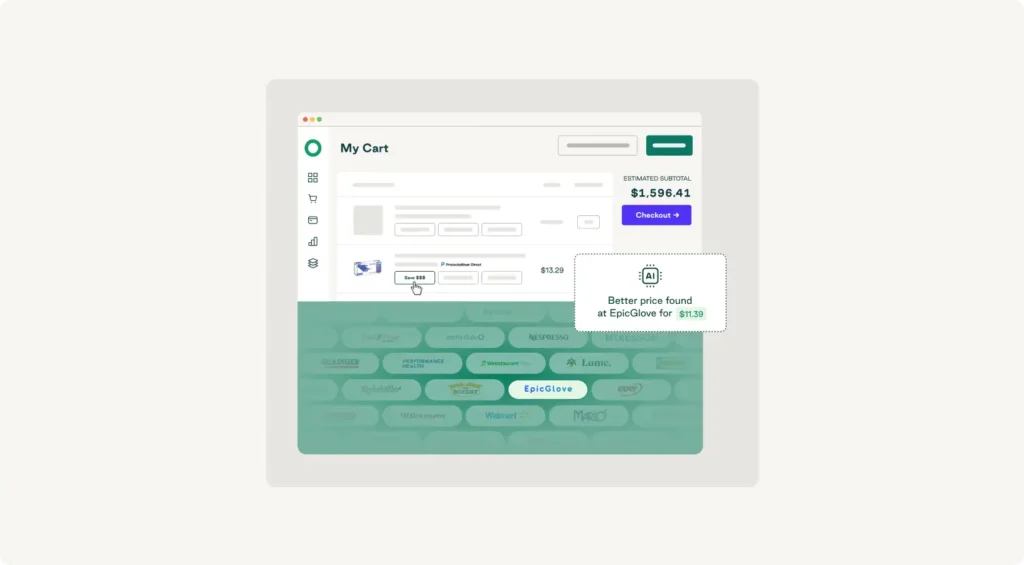
- A sourcing algorithm that finds better prices and flags alternative vendors automatically when your usual pick is out of stock or costs more than it should
- Automated ordering and fulfillment, from requisition and approval through purchasing, tracking, and delivery, all in one platform
- Line-item GL tagging that codes every purchase to the correct account, cost center, and entity, not just at the PO level
- Reporting tools that break down data siloes and give you full visibility into spend for KPI tracking and analysis
This combination is especially valuable if your business runs on high-volume physical goods spend, like packaging, supplies, or facilities items ordered across multiple locations. Instead of juggling dozens of supplier relationships and manual reorders, you get one system to source, order, and pay across your entire vendor network.
How to get started improving your procurement process
You don't need to overhaul everything at once. Here are a few practical starting points to improve your procurement process:
- Audit your current state. Map out how a purchase actually moves today, from request to payment, and note every manual handoff.
- Identify who owns what. Clarify which teams are responsible for sourcing, approvals, and payment so nothing falls through the cracks.
- Find your top three friction points. Look for the steps that take the longest or cause the most errors, whether that's approvals, sourcing, or vendor onboarding.
- Pilot automation on your highest-volume category. Start with the vendor or product category you order from most often. That's where automation will save the most time and show the quickest results..
Once you see results in that category, expanding the process to the rest of your spend is a much easier case to make. Tools like intelligent procurement platforms make that expansion faster, since the sourcing and approval logic you set up for one category carries over to the next.
Ready to see what a fully automated procurement process looks like? Schedule a demo with Order.co to see how it can save you money and improve your team's buying habits.
FAQs about the procurement process
Procurement is the process of sourcing, buying, and paying for goods and services. Supply chain management is broader. It covers everything involved in getting a product from raw materials to the end customer, including logistics, manufacturing, and inventory. Procurement is one function within the larger supply chain.
It depends on the purchase and the company, but industry data puts the median requisition-to-PO cycle time around 55 hours. Larger or more strategic purchases that require an RFP process often take longer.
Start with your highest-volume category or the step causing the most delays, often purchase approvals or invoice matching. Automating the most frequent, repetitive part of the process delivers the fastest, most visible return.
Yes, for very small or low-risk purchases, some companies skip the formal PO step. But for most purchases, especially anything recurring or above a certain dollar threshold, a PO creates a clear record and protects both sides if there's a dispute.
Centralized procurement routes purchasing decisions through one team, which improves consistency, compliance, and vendor leverage. Decentralized procurement lets individual departments or locations buy on their own, which can be faster but makes it harder to control spend and maintain visibility across the business.
Get started
Schedule a demo to see how Order.co can simplify buying for your business.
"*" indicates required fields